Showing posts with label uk. Show all posts

Saturday, May 09, 2009

British anti-terror laws lead to searches every three minutes

I was stunned to read that British police use new anti-terror powers to stop and search people every three minutes. Section 44 of the Terrorism Act has been used 170,000 to search people in 2008 alone according to the BBC. (See: BBC NEWS | England | London | Capital sees rise in terror stops.) These searches have led to 65 arrests (0.035% success) and zero convictions (0.000% success). Of course there are no official stats on how many times Section 44 was used as a pretense for some other motive.

Draw your own conclusions.

Via London cops catch and search a potential terrorist every three minutes - Boing Boing.

Saturday, April 11, 2009

Monday, April 06, 2009

European internet firms must start logging communications as of today

As of today, all internet service providers in Europe are required by law to retain information about every e-mail and VOIP call made by their users thanks to the European Data Retention Directive.

BBC NEWS Technology Net firms start storing user data

Details of user e-mails and net phone calls will be stored by internet service providers (ISPs) from Monday under an EU directive.

The plans were drawn up in the wake of the London bombings in 2005.

ISPs and telecoms firms have resisted the proposals while some countries in the EU are contesting the directive.

Jim Killock, executive director of the Open Rights Group, said it was a "crazy directive" with potentially dangerous repercussions for citizens.

All ISPs in the European Union will have to store the records for a year. An EU directive which requires telecoms firms to hold on to telephone records for 12 months is already in force.

The data stored does not include the content of e-mails or a recording of a net phone call, but is used to determine connections between individuals.

Authorities can get access to the stored records with a warrant.

Governments across the EU have now started to implement the directive into their own national legislation.

The UK Home Office, responsible for matters of policing and national security, said the measure had "effective safeguards" in place.

There is concern that access to our data is widening to include many public bodies ISPs across Europe have complained about the extra costs involved in maintaining the records. The UK government has agreed to reimburse ISPs for the cost of retaining the data.

Mr Killock said the directive was passed only by "stretching the law".

The EU passed it by "saying it was a commercial matter and not a police matter", he explained.

"Because of that they got it through on a simple vote, rather than needing unanimity, which is required for policing matters," he said.

Sense of shock

He added: "It was introduced in the wake of the London bombings when there was a sense of shock in Europe. It was used to push people in a particular direction."

Sweden has decided to ignore the directive completely while there is a challenge going through the German courts at present.

"Hopefully, we can see some sort of challenge to this directive," said Mr Killock.

Isabella Sankey, Policy Director at Liberty, said the directive formalised what had already been taking place under voluntary arrangement for years.

"The problem is that this regime allows not just police to access this information but hundreds of other public bodies."

In a statement, the Home Office said it was implementing the directive because it was the government's priority to "protect public safety and national security".

It added: "Communications data is the where and when of the communication and plays a vital part in a wide range of criminal investigations and prevention of terrorist attacks, as well as contributing to public safety more generally.

"Without communications data resolving crimes such as the Rhys Jones murder would be very difficult if not impossible.

"Access to communications data is governed by the Regulation of Investigatory Powers Act 2000 (Ripa) which ensures that effective safeguards are in place and that the data can only be accessed when it is necessary and proportionate to do so."

And, as an aside, I'm not sure many will find comfort in the idea that RIPA will act to protect privacy: RIPA surveillance may break human rights laws - ZDNet.co.uk.

Wednesday, March 25, 2009

Google Street View's privacy enhancing technology?

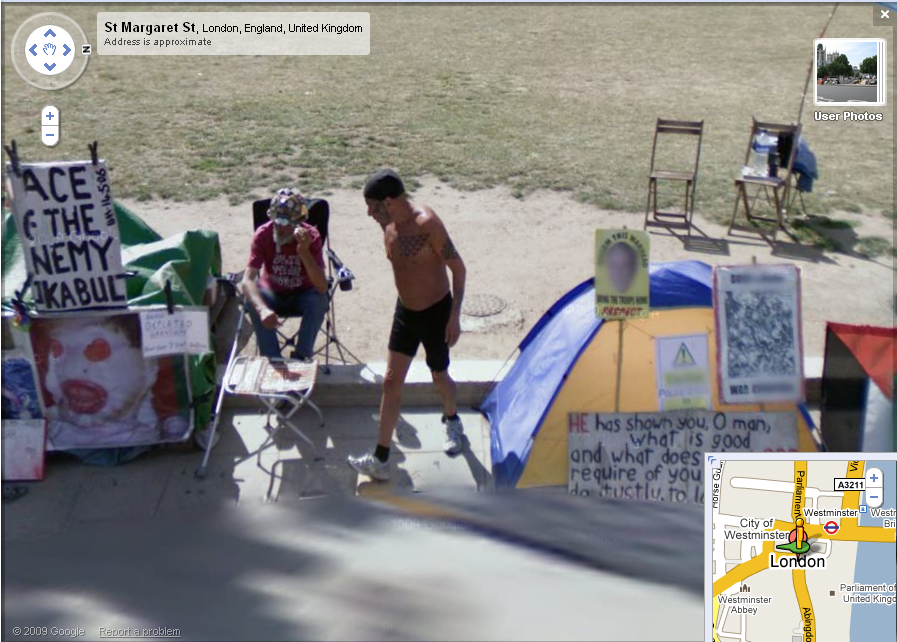
With Google's recent launch of Street View in Europe and imminent photographing of Canadian cities, I thought I'd do some quick looking around at how effective their "face blurring" technology may be. It only took one minute of wandering around London and I was able to see where it might fall off the rails.

In this particular image, the anti-war protesters are recognizable but - THANKFULLY - the image of what's probably George W. Bush has been blurred out. But not blurred to the point of non-recognition.

Google: You've come a long way, baby, but there's work to be done.

Sunday, March 22, 2009

Thursday, October 16, 2008

The British Government plans to step in to the abyss with massive telecom database

The Independent is reporting that the British government is planning to announce a 1 BILLION POUND project that would involve the creation of a database to log every e-mail, telephone call and website click and retain the information for one year.

The project seems to be universally panned: the independent reviewer of UK anti-terrorism laws says "as a raw idea it is awful". The Information Commissioner calls it a "step too far".

If anyone had asked me (which they didn't, but I have constitutional rights here in Canada and get to say what I want), I would have said the idea is not surprising given the way things are going in England, but it is a clear step into the abyss of giving up any sense of private life in the country. See: Exclusive: Storm over Big Brother database - Home News, UK - The Independent. Big thanks to DP thinker: Proposed Database for pointing to the story.

Friday, October 10, 2008

Missing hard-drive in the UK contains info on 100K military personnel

The Daily Express is reporting that a contractor has misplaced a portable hard drive containing the personal information on over 100,000 military personnel. See: MPS 'FURIOUS' AS MOD DATA MISSING.

Over-the-top (or under-the-foliage) surveillance leads to backlash in the UK

The ridiculous degree of surveillance in the UK, supported by the Regulation of Investigatory Powers Act, is finally leading to a significant backlash as surveillance powers are being used to catch people who don't scoop their poop. Thanks to Rob Hyndman for the link.

Orwellian U.K. Angers People With Tree Cameras, Snooping Kids

By Caroline Alexander and Howard Mustoe

Oct. 10 (Bloomberg) -- Hidden in foliage next to a path in the southeast England seaside town of Hastings are digital cameras. Their target: litterbugs and dog walkers.

The electronic eyes feed images to a monitoring unit, where they're scanned and stored as evidence to prosecute people who discard garbage or fail to clean up after pets, a spokeswoman for the town council said.

``It's becoming a bit Big Brother-like,'' said Sandra Roberts, 50, a Hastings kiosk manager, invoking George Orwell's 1949 book ``Nineteen Eighty-Four,'' about a Britain where authorities pry into all aspects of citizens' lives.

Local authorities are adopting phone-record logging, e-mail taps and camera surveillance to police such offenses as welfare fraud, unlawful dumping of waste and sick-day fakery. Telecommunications companies are about to join the list of crime monitors. Already, 4.5 million closed-circuit cameras watch public places across Britain, or about 1 camera for every 15 people, the highest ratio in the world.

``There's too much of it now, all this spying,'' said Ivor Quittention, 80, a retired owner of three hardware stores who lives in Hastings. The town's spokeswoman, who declined to be identified, said spying is the most effective way of dealing with something residents complain about most.

The Regulation of Investigatory Powers Act, dubbed ``the snoopers charter'' by London-based civil-rights group Liberty, was passed by the ruling Labour Party in 2000 to legislate methods of surveillance and information gathering. The purpose of the law, known also as Ripa, was to help prevent crime, including terrorism, according to the Home Office.

`Too Much Power'

Initially, only security and intelligence services could invoke the Act's provisions. In 2003, Parliament extended powers to the 474 local councils in England, Scotland and Wales, as well as to 318 other state bodies, including 11 Royal Parks, the Post Office and Chief Inspector of Schools.

Since then, local authorities have been expanding their use of the provisions to dozens of lesser offenses.

The law has loopholes and councils like Hastings aren't doing anything wrong when they invoke it for minor crimes, according to Gus Hosein, a professor from the London School of Economics specializing in technology and privacy.

``Ripa just gives too much power to any Tom, Dick or Harry related to government,'' he said.

The latest proposed expansion of the Act requires telecommunications providers to store the text of all e-mails and details of all phone calls transmitted over their lines.

The government is seeking the views of the public on the proposal until Oct. 31. The bill will then go to Parliament for consideration.

`Sleep-Walking'

Of the 163 U.K. councils that replied to calls and Freedom of Information requests from Bloomberg, 95 percent said they use Ripa. Nine said they don't, including Barnet, Basingstoke and Deane, Broadland, Halton, Harrogate, Shepway, West Devon, Slough and the Shetlands, a group of islands off Scotland where sheep outnumber people. Three declined to provide details without payment of an administrative fee.

East Hampshire, in south England, applied the law to catch vandals defacing tombstones. Derby, in northern England, invoked it to send children with recording gear into shops to see if they'd unlawfully be sold cigarettes and alcohol.

``It's unreal,'' said Dean Price, 24, a graphic designer in London. ``We've been sleep-walking into this. Everyone talks about Orwell and 1984 but no one ever does anything about it.''

A spokesman for the Home Office, which oversees Ripa, said the extension is vital to intelligence gathering and will help investigators identify suspects, track them and examine their contacts. He declined to be identified, in line with policy.

Petty Offenses

The Association of Local Government, which represents councils, said through a statement by outgoing Chairman Simon Milton that the ``crime-busting powers'' are an essential tool in gathering evidence needed to stop criminal activity.

At the same time, Milton said he wrote to all councils in June asking them not to invoke the law for petty offenses.

``It's ironic that a nation that was once a bastion of privacy, one in which `an Englishman's home is his castle' and that did away with National ID Cards in 1952, is now one of the most surveilled in the world,'' said Toby Stevens, founder of London's Enterprise Privacy Group.

The opposition Conservative Party is against Ripa in its current form and will amend it if it wins the next election, due by 2010, home affairs spokesman Dominic Grieve said.

Mark Jewell, a councilman for the U.K.'s third party, the Liberal Democrats, said more checks and balances are needed to ensure Ripa isn't abused. ``At the moment, you don't need to have done anything wrong to get snooped on,'' he said. No other European Union government has similar regulations.

`Hugely Disproportionate'

Among councils which responded to Bloomberg's questions, those in northern England, Wales and Scotland used the law more than those in the south. Durham, in northeast England, was the biggest user, invoking the provisions 144 times in the past year, as authorities cracked down on offenses including fraud.

In April, council workers spent two weeks tailing a couple in Poole, southeast England, they wrongly suspected were planning to send their daughter to a school outside their designated area. Tim Joyce and Jenny Paton called the intrusion into their lives ``hugely disproportionate.''

In August, Paul Griffiths was taken to court and fined 1,000 pounds for allowing his dog to foul grass outside his home in Bristol. Griffiths said he's innocent and his pet had only been urinating when she was spotted on camera.

Brian Clements, a 79-year-old retired teacher from Clacton- on-Sea, south England, said the measures are ``like using a sledge hammer to crack a nut.''

``Wouldn't the Gestapo have loved all those little cameras,'' he said.

To contact the reporter on this story: Caroline Alexander in London at calexander1@bloomberg.net.

Last Updated: October 9, 2008 19:01 EDT

Monday, September 29, 2008

Crowdsourced photo survey of the UK surveillance state

The Open Rights Group in the UK is planning to crowdsource a photographic survey of the United Kingdom's surveillane aparatus on October 11. Participants are encouraged to:

  1. Spot something that embodies the UK’s wholesale transformation into the surveillance society/database state. Subjects might include your local CCTV camera(s), or fingerprinting equipment in your child’s school library
  2. Snap it
  3. Upload it to Flickr and tag it “FNFBigPicture” - please use an Attribution Creative Commons license*

Check out: The Open Rights Group : Blog Archive » Capturing the database state: community photocall. I'll post a selection of the photos on the blog. (Via the ever-vigilant Boing Boing.)

Sunday, September 28, 2008

Unsurprising expansion of UK surveillance project

A system designed to track motorists in the UK is being expanded to collect fifty million automobile movement records for five years, instead of the already intrusive two years originally announced. Alread pervasive CCTV cameras are being upgraded to capture license plates, adding to what is being said to be the largest oracle database in Europe.

See: Fears over privacy as police expand surveillance project UK news The Guardian.

Thanks to SpyBlog.org.uk for the link.

Friday, July 25, 2008

Mosley's privacy win in English courts

It's a busy week for privacy cases in the English courts. The media has widely reported on the case of Max Mosley, the Grand Prix boss, who has successfully sued the News of the World. The publication placed a hidden camera in a private residence and filmed Mosley in an intimate encounter. The paper suggested that he participated in a sadomasochistic orgy that attempted to recreate a Nazi death camp atmosphere.

In seeking to protect his privacy, the whole event has been thrown into the public arena. And consistent with other privacy cases, the quantum of damages is surprisingly low given the impact that this has had on Mosley.

The decision can be found here.

From the New York Times:

British Judge Rules Tabloid Report Tying Grand Prix Boss to ‘Orgy’ Violated Privacy - NYTimes.com

LONDON — In a ruling with potentially wide implications for press freedom in Britain, a judge ruled Thursday that a tabloid newspaper breached the privacy of Max Mosley, the overseer of grand prix motor racing, when it published an article in March claiming that he had participated in a sadomasochistic “orgy” with a Nazi theme.

The judge, Sir David Eady, awarded Mr. Mosley, 68, damages equivalent to about $120,000 and legal costs estimated to be at least $850,000 in his lawsuit against The News of the World.

The ruling upheld the central arguments by Mr. Mosley and his lawyers: that there had been no Nazi theme to the five-hour sex session in an apartment in the Chelsea district of London that was secretly filmed by the newspaper, and no issue of public interest in its decision to splash the article on its front page and post video on its Web site.

“I found that there was no evidence that the gathering of March 28, 2008, was intended to be an enactment of Nazi behavior or adoption of any of its attitudes,” the judge wrote.

He added that Mr. Mosley had a “reasonable expectation” of privacy for sexual activities that took place on private premises and that did not involve violations of the criminal law.

“There was no public interest or other justification for the clandestine recording, for the publication of the resulting information and still photographs, or for the placing of the video extracts on The News of the World Web site — all of this on a massive scale,” the judge said.

But he denied Mr. Mosley the “punitive damages” he had sought, which could have amounted to millions of dollars. The damage done to Mr. Mosley’s reputation by “the embarrassing personal information” disclosed by the newspaper “cannot be mitigated by simply adding a few noughts to the number first thought of,” the judge said.

Outside the court, Mr. Mosley said he was delighted with the ruling, which he described as “devastating” to The News of the World.

“It demonstrates that their Nazi lie was completely invented and had no justification,” he said. “It also shows that they had no right to go into private premises and take pictures and film of adults engaged in activities which are no one’s business but those of the people concerned.”

The ruling was one of several by Justice Eady and other judges in recent years in privacy cases against British newspapers under a provision of the European Convention on Human Rights. Some legal experts say the rulings have shifted the balance in Britain in favor of celebrity plaintiffs and against newspapers and other media organizations in invasion-of-privacy cases.

Justice Eady, in his finding, said his ruling should not be considered “a landmark case,” but rather “the application to rather unusual facts” in the Mosley case of privacy principles that had been developing in British court judgments in recent years. Still, the ruling caused a stir among lawyers fighting for press freedoms, some of whom said it was a bellwether for a new, more restrictive era of news media coverage of people in the public domain.

Other lawyers cautioned against alarmism, saying British courts would continue to weigh two competing provisions in the European rights convention — Article 8, establishing a right of privacy, and Article 10, protecting press freedoms — and that it was too early to know where the lasting balance would be struck.

“One lesson it teaches is that public figures can have a private life,” said Desmond Browne, a barrister who has represented some of the plaintiffs in headline-making privacy cases.

Editors of some of Britain’s more serious newspapers also were wary about drawing instant conclusions about where press law in Britain was headed.

Roger Alton, editor of The Independent, a newspaper known for the rigor of its investigative journalism, said he was not too troubled by the ruling.

“It’ll affect kiss-and-tell stories,” Mr. Alton told the British Broadcasting Corporation. “But it’s not a landmark. It’s not going to set things up in a completely different way.”

But Colin Myler, editor of The News of the World, said the judgment was based on precedents established by “judges in Strasbourg,” seat of the European Court of Human Rights, and that the issues involved had never been addressed by Britain’s Parliament. “As a result, our media are being strangled by stealth,” he said.

For Mr. Mosley, success in the case represented at least a partial vindication of what amounted to a gamble. Rather than resigning in shame, as have many well-known figures caught in sex scandals, Mr. Mosley chose another route. He admitted to a passion for sadomasochism, which he told the court had continued for 45 years, and discussed, from the witness box, details of what had occurred in the Chelsea apartment.

But the aspect of the article that he, and many of his detractors in the world of motor racing and beyond, considered the most damaging was the claim that the session involved a conscious effort to recreate the atmosphere of a Nazi death camp.

The potential damage to Mr. Mosley was linked, inevitably, to the fact that he is the son of Sir Oswald Mosley, leader of Britain’s National Union of Fascists in the 1930s, whose secret marriage to Mr. Mosley’s mother, Diana, took place at the home of the Nazi propaganda chief Joseph Goebbels in 1936, with Hitler as guest of honor.

In court, lawyers for The News of the World said they based their claim of a Nazi theme, in part, on the use of commands in guttural German or German-accented English by Mr. Mosley and the women involved. But Mr. Mosley and four of the five women involved maintained that what they intended in their role-playing was to recreate a generic prison scene, not a Nazi death camp.

Thursday, July 24, 2008

English case looks under the hood of Facebook in privacy case

A colleague just brought to my attention a case handed down yesterday by the High Court of Justice (Queen's Bench Division) of England & Wales: Applause Store Productions Ltd. & Anor v Raphael [2008] EWHC 1781 (QB) (24 July 2008).

The case relates to the misuse of private information and defamation. The defendant in this case had set up a false Facebook profile in the name of the plaintiff and established a Facebook group that was, shall we say, not flattering of the plaintiff. The court found in favour of the defendant on both claims.

What's additionally interesting is the detail with which the Court reviews the logging data generated by Facebook and provided to the Court. The case is an interesting read for privacy issues, but also is a good chance to look under the hood of Facebook, forensically speaking.

Saturday, June 28, 2008

Marina Hyde: This surveillance onslaught is draconian and creepy

Because actions speak louder than words, one can easily assume that the British populace is completely passive and accepting of the explosion of CCTV surveillance throughout the green and pleasant lands of England. There is some dissent. Witness: Marina Hyde who has an interesting opinion piece in The Guardian.

Marina Hyde: This surveillance onslaught is draconian and creepy Comment is free The Guardian

Closed-circuit TV cameras are the crime-fighting tool so fiendishly sophisticated that they can be foiled by the wearing of a hood. Yet having stuck 4.2 million of the things around this country, with nary a consultation on the matter - nor any significant impact on crime statistics - efforts to pimp them to 2.0 status continue

This week it emerged that scientists at Portsmouth University are developing "listening" cameras. Artificial intelligence software will be able to recognise sounds such as breaking glass, so that, when such a noise is detected, they can rotate in its direction and capture the act of vandalism/terrorism/God that resulted in a milk bottle falling off your doorstep. I paraphrase slightly, but given that the most recent Home Office report on the matter found that better street lighting is seven times more effective at cutting crime than CCTV, the truly suspicious behaviour is our deepening obsession with surveillance.

The past few years have thrown up dozens of instances which made one wince to be a citizen of this septic isle, but a personal low came with the discovery that 500,000 bins had been fitted with electronic tracking devices. Transponders in bins ... Could any morning news item be more designed to force one back against the pillows, too embarrassed about one's country to start the day? Yes, as it turned out. A couple of months ago it was discovered that Poole borough council, in Dorset, had used the Regulation of Investigatory Powers Act - designed to track serious criminals and terrorists - to determine whether a school applicant and her parents lived where they said they did. They did, and were appalled to discover they had been spied on for three weeks, the subject of surveillance notes such as "female and three children enter target vehicle and drive off". Target vehicle, if you please! The thought of some deep-cover council drone jotting this stuff down as though it were an elite Delta Force operation is not as funny as it is horrifying.

Just who are these people, these swelling legions of unelected, ill-qualified monitors who wield such extraordinary power in our surveillance society? Clarification in one case came last year, when the civilian in charge of a Worcester police station's surveillance team was suspended after detectives found, among one day's footage, a 20-minute sequence of close-ups of a woman's cleavage and backside as she walked oblivious through the streets. Whether the woman ever discovered she was the star of a kind of pervert Truman Show is not recorded. But the offending monitor escaped with a warning and was - unbelievably - back in post within weeks.

In some city centres, such as Middlesbrough, speakers have been put on the cameras, so that those monitoring can interact with potential miscreants. Let's hope these remote bossy boots imagine they're involved in some high-level negotiation, in which they talk down a teenager from his decision to drop a hamburger wrapper on the pavement.

The former home secretary John Reid, on whose draconian watch the Middlesbrough scheme was approved, even suggested at its launch that schoolchildren should enter a competition to become the voice of the cameras - once again laying bare the government's desire to co-opt its citizens into the surveillance process at all levels. We are, of course, coming up to the time of year when we are ordered to shop our neighbours for acts of hosepipe, while the Shoreditch Trust recently trialled a scheme encouraging residents to watch live CCTV feeds on a special local channel, the better to assist in policing.

For all this creepy "outreach", though, the only hands-down beneficiaries of our CCTV obsession (apart from the revenue gatherers) have been broadcasters. For no good reason, all manner of TV networks have been furnished with hours of footage to pad out their witless police chase documentaries, or offensively cheap "street crime UK" shows. Britain's CCTV network: proudly supporting the Bravo channel.

The worst thing is the blithe insistence that this is all necessary and normal. We are watched more closely, by more cameras, with each passing day. But so faultlessly designed is our society that we have never come close to having a say on it.

There's a great bit in Woody Allen's movie Deconstructing Harry when Robin Williams's character goes out of focus, appearing as a sort of fuzzy version of himself, which sounds increasingly like the sort of sickness that should be courted by any attractive woman keen to walk through Worcester. That said, she could always don a hood. Yet there does seem a vaguely depressing irony in governments insisting that constant surveillance is essential to prevent our being overrun by repressive regimes who'd make us all cover our heads and the like. It's these initiatives that drive even the most pliant members of society to dream of taking just that precaution themselves, if only for a bit of privacy.

Sunday, June 01, 2008

Mobile phones used as "cookies" in the offline world to track shoppers

According to the Times, some shopping centres in the UK have started using a system that tracks shoppers using the unique signals produced by customers' mobile phones. The Information Commissioner has cautiously approved the technology:
Shops track customers via mobile phone - Times Online

The surveillance mechanism works by monitoring the signals produced by mobile handsets and then locating the phone by triangulation ­ measuring the phone’s distance from three receivers.

[....]

The Information Commissioner's Office (ICO) expressed cautious approval of the technology, which does not identify the owner of the phone but rather the handset's IMEI code -- a unique number given to every device so that the network can recognise it.

But an ICO spokesman said, "we would be very worried if this technology was used in connection with other systems that contain personal information, if the intention was to provide more detailed profiles about identifiable individuals and their shopping habits.”

Only the phone network can match a handset's IMEI number to the personal details of a customer.

Path Intelligence, the Portsmouth-based company which developed the technology, said its equipment was just a tool for market research. "There's absolutely no way we can link the information we gather back to the individual,” a spokeswoman said. “There's nothing personal in the data."

Liberty, the campaign group, said that although the data do not meet the legal definition of ‘personal information’, it "had the potential" to identify particular individuals' shopping habits by referencing information held by the phone networks.

This is similar to a form of "cookies" for the offline world. On the one hand, we have assurances that the phones' serial number will not be connected with other personal information, but there really is no assurance that will not happen. And once this information is collected, it will be in the system available to law enforcement and others who do have the ability to match it to personal information.

Via Schneier on Security: Tracking People with their Mobile Phones.

Wednesday, April 30, 2008

A new place to put cameras: Lollipops!

England, well beyond the cutting edge of surveillance, has found a new place to put cameras: in the lollipop-shaped signs used by crossing guards.

Campaign to lick lollipop rage UK news guardian.co.uk

For generations, lollipop men and women have shepherded schoolchildren safely across roads armed only with their trusty signs.

But they are about to undergo a Robocop-style makeover: their signs are to be equipped with cameras in an effort to combat "lollipop rage" by aggressive drivers.

The new signs, which cost £890 each, will allow lollipop men and women - officially known as school crossing patrol officers - to record dangerous driving and capture car number plates, say council leaders.

Friday, April 18, 2008

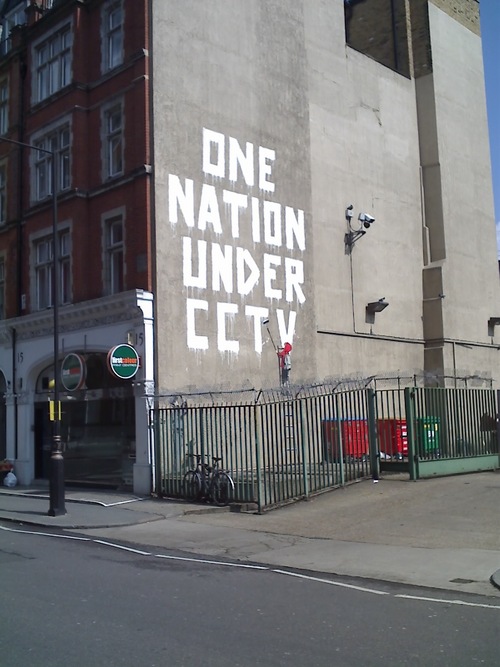
One Nation Under CCTV graffiti in London

World famous British street artist Banksy has a message about the widespread CCTV in England and has chosen a large wall as the medium to express it. Via ONE NATION UNDER CCTV graffito in London - Boing Boing. See also Banksy pulls off daring CCTV protest in London - Telegraph.

Greater details in this Flickr set.

Wednesday, April 16, 2008

British local council uses criminal law to spy on school place applicants

Here is a shocking example of why intrusive powers need to be carefully circumscribed and subject to judicial oversight, otherwise they will be abused.

A local council in the UK (not surprisingly) has used the Regulation of Investigatory Powers Act, designed for serious crimes and terrorism, to surveil a three-year-old to determine if her parent's were misrepresenting place of abode to get into a better school. See: Council uses criminal law to spy on school place applicants Society The Guardian.

"The Home Office said the RIPA legislation did not appear to have been used inappropriately."

Friday, April 11, 2008

London beat cops upset over Big Brother surveillance scheme

Some people, I am sure, will savor the irony that many London police officers are complaining about creepy surveillance and Big Brother tactics inherent in a new technology that will allow desk-riding senior cops to keep tabs on the location and activities of cops on the beat.

Apparently they don't like feeling like they're being watched. Some are concerned that innocent and lawful activities could be misinterpreted. Oh, and others are worried that information originally collected for safety and resource planning may be used for some other purpose. Pity.

Check it out:

Met Police officers to be 'microchipped' by top brass in Big Brother style tracking scheme the Daily Mail

Every single Metropolitan police officer will be 'microchipped' so top brass can monitor their movements on a Big Brother style tracking scheme, it can be revealed today.

According to respected industry magazine Police Review, the plan - which affects all 31,000 serving officers in the Met, including Sir Ian Blair - is set to replace the unreliable Airwave radio system currently used to help monitor officer's movements.

The new electronic tracking device - called the Automated Personal Location System (APLS) - means that officers will never be out of range of supervising officers.

But many serving officers fear being turned into "Robocops" - controlled by bosses who have not been out on the beat in years.

According to service providers Telent, the new technology 'will enable operators in the Service's operations centres to identify the location of each police officer' at any time they are on duty - whether overground or underground.

Although police chiefs say the new technology is about 'improving officer safety' and reacting to incidents more quickly, many rank and file believe it is just a Big Brother style system to keep tabs on them and make sure they don't 'doze off on duty'.

Some officers are concerned that the system - which will be able to pinpoint any of the 31,000 officers in the Met to within a few feet of their location - will put a complete end to community policing and leave officers purely at the beck and call of control room staff rather than reacting to members of the public on the ground.

Pete Smyth, chairman of the Met Police Federation, said: "This could be very good for officers' safety but it could also involve an element of Big Brother.

"We need to look at it very carefully."

Other officers, however, were more scathing, saying the new system - set to be implemented within the next few weeks - will turn them into 'Robocops' simply obeying instructions from above rather than using their own judgement.

One officer, working in Peckham, south London, said: "They are keeping the exact workings of the system very hush-hush at the moment - although it will be similar to the way criminals are electronically tagged. There will not be any choice about wearing one.

"We depend on our own ability and local knowledge to react to situations accordingly.

"Obviously we need the back up and information from control, but a lot of us feel that we will simply be used as machines, or robots, to do what we are told with little or no chance to put in anything ourselves."

He added: "Most of us joined up so we could apply the law and think for ourselves, but if Sarge knows where we are every second of the day it just makes it difficult."

Another officer, who did not want to be named, said: "A lot of my time is spent speaking to people in cafes, parks or just wherever I'm approached. If I feel I've got my chief breathing down my neck to make another arrest I won't feel I'm doing my job properly."

The system is one of the largest of its kind in the world, according to Telent, the company behind the technology, although neither the Met nor Telent would provide Police Review with any more information about exactly how the system will work or what sort of devices officers will wear.

Nigel Lee, a workstream manager at the Met, said: "Safety is a primary concern for all police forces.

"The area served by our force covers 620 miles and knowing the location of our officers means that not only can we provision resource more quickly, but should an officer need assistance, we can get to them even more quickly."

Forces currently have the facility to track all their officers through GPS devices on their Airwave radio headsets, but this is subject to headsets being up to date and forces buying the back office systems to accompany them, according to Airwave.

Steve Rands, health and safety head for the Met Police Federation, told Police Review: "This is so that we know where officers are. Let us say that when voice distortion or sound quality over the radio is lost, if you cannot hear where that officer telling you where he is, you can still pinpoint his exact position by global positioning system.

"If he needs help but you cannot hear him for whatever reason, APLS will say where he is."

Sunday, January 27, 2008

UK Commissioner seeks additional powers and penalties

In stark contrast to Canada's Privacy Commissioner, the Information Commissioner in the UK is looking for stronger powers and penalties. See: IMPACT®: ICO publishes powers and penalties wishlist, which refers to "DATA PROTECTION POWERS AND PENALTIES: The Case for Amending the Data Protection Act 1998".

Sunday, January 20, 2008

Incident: Personal info on 600K UK military recruits on stolen laptop

The Register reports that a laptop containing the personal information of 600,000 UK military recruits was on a laptop stolen from a naval officer's car. See: Join the army, get your ID pinched - MoD laptop goes AWOL | The Register.